When a parent starts losing teeth, dental implants often come up as the next step.
But the explanation you actually hear at the clinic can be more complicated than expected.
Many people assume implants become completely free once you turn 65 — that’s not quite right.
So exactly how many dental implants over 65 does health insurance cover?
Key Takeaway
Health insurance subscribers age 65 and older can get coverage for up to 2 implants per lifetime.
The standard copay is 30% of the covered treatment cost, and patients with no remaining natural teeth (fully edentulous) are excluded.
Extra costs like bone grafts aren’t covered and are billed separately.
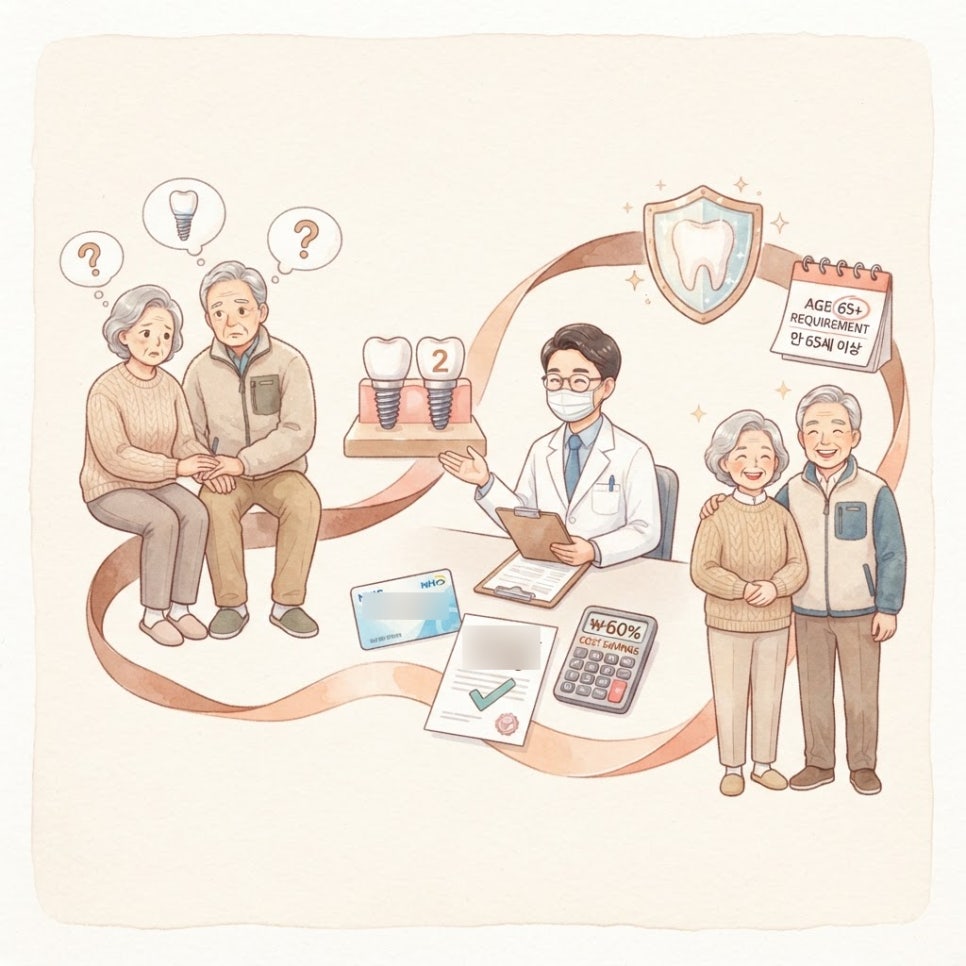
Patients often get confused about dental implants over 65 coverage during consultations.
This guide walks through the coverage limit, who qualifies, a sample copay calculation, and the application process, in order.
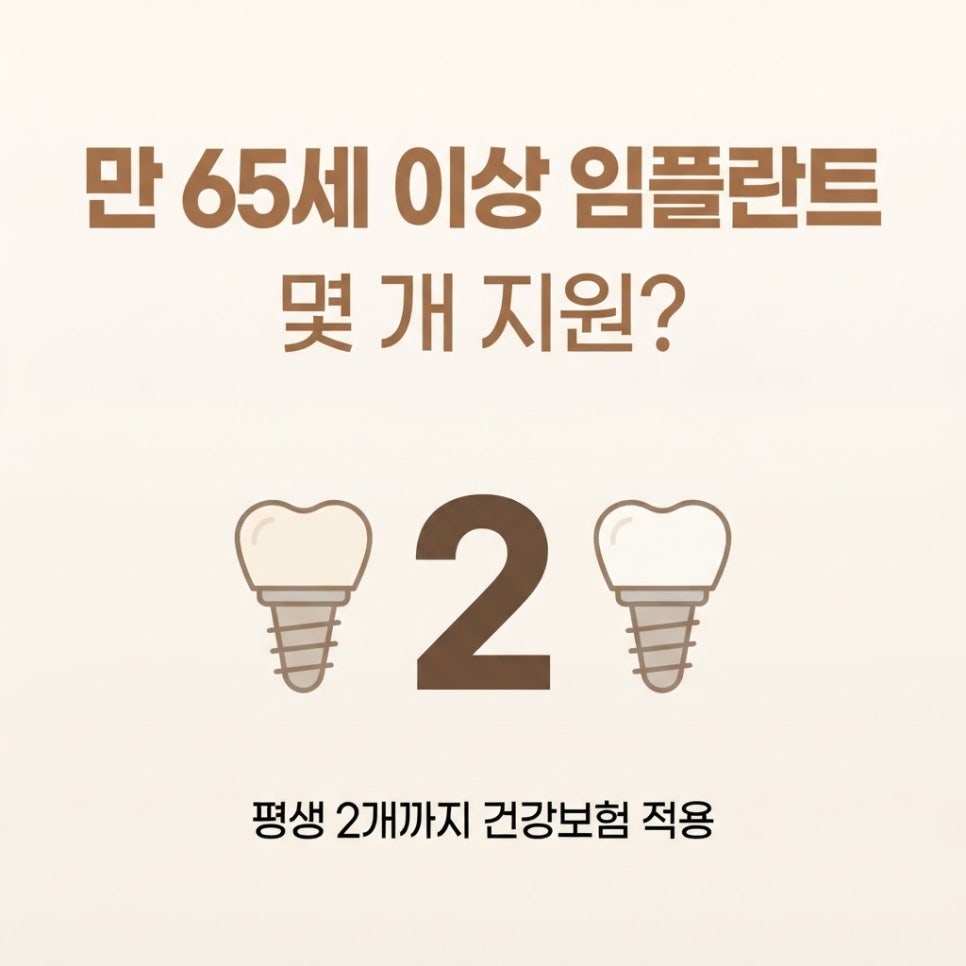
How Many Dental Implants Does Health Insurance Cover After 65?
The short answer: 2 implants per person, for life.
This is not a benefit that resets every year — it’s a one-time lifetime allowance.
Health insurance-covered implants are a benefit that provides coverage for up to 2 implants, for life, to partially edentulous patients age 65 and older.
The limit of 2 applies across the upper and lower jaw combined — once you’ve used both, additional coverage generally isn’t available.
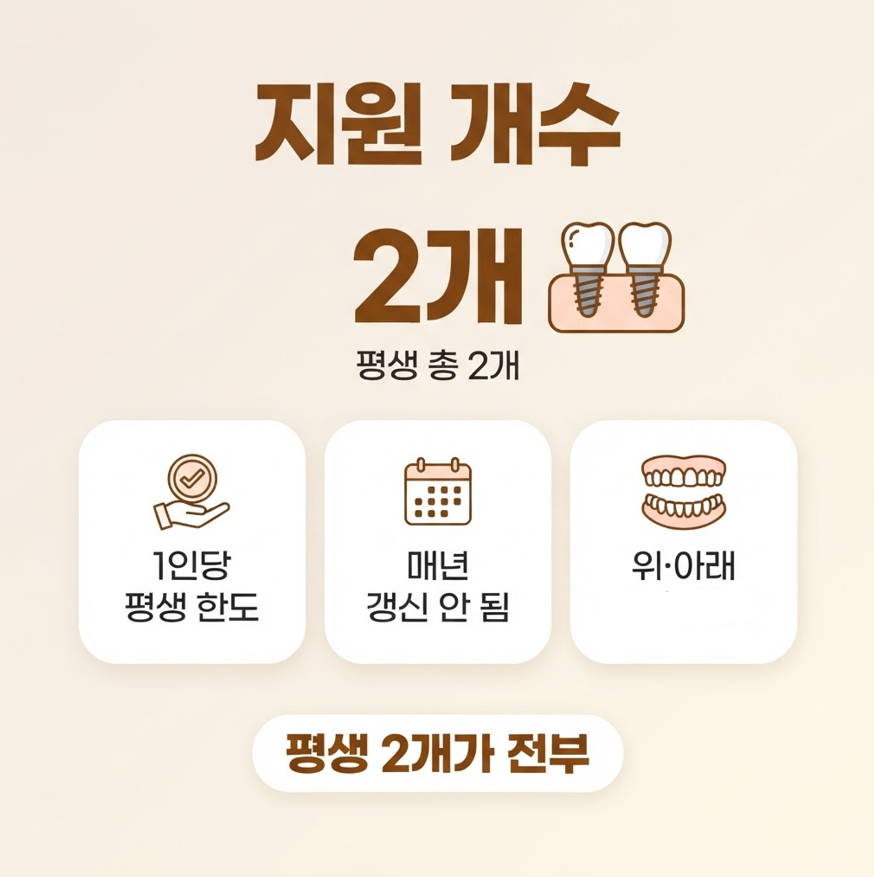
For example, if you’ve lost 3 teeth,
2 implants may be covered, but the third is often treated as a non-covered, out-of-pocket procedure.
✔ Health insurance covers up to 2 implants per lifetime
✔ The 2-implant limit combines the upper and lower jaw
✔ No additional coverage once both have been used
Who Qualifies for Health Insurance-Covered Implants?
No. You need to meet both an age requirement and an oral health condition.
Eligible patients are health insurance subscribers or dependents age 65 or older who are partially edentulous (missing some, but not all, teeth).
Patients with no remaining natural teeth at all (fully edentulous) are excluded from coverage.
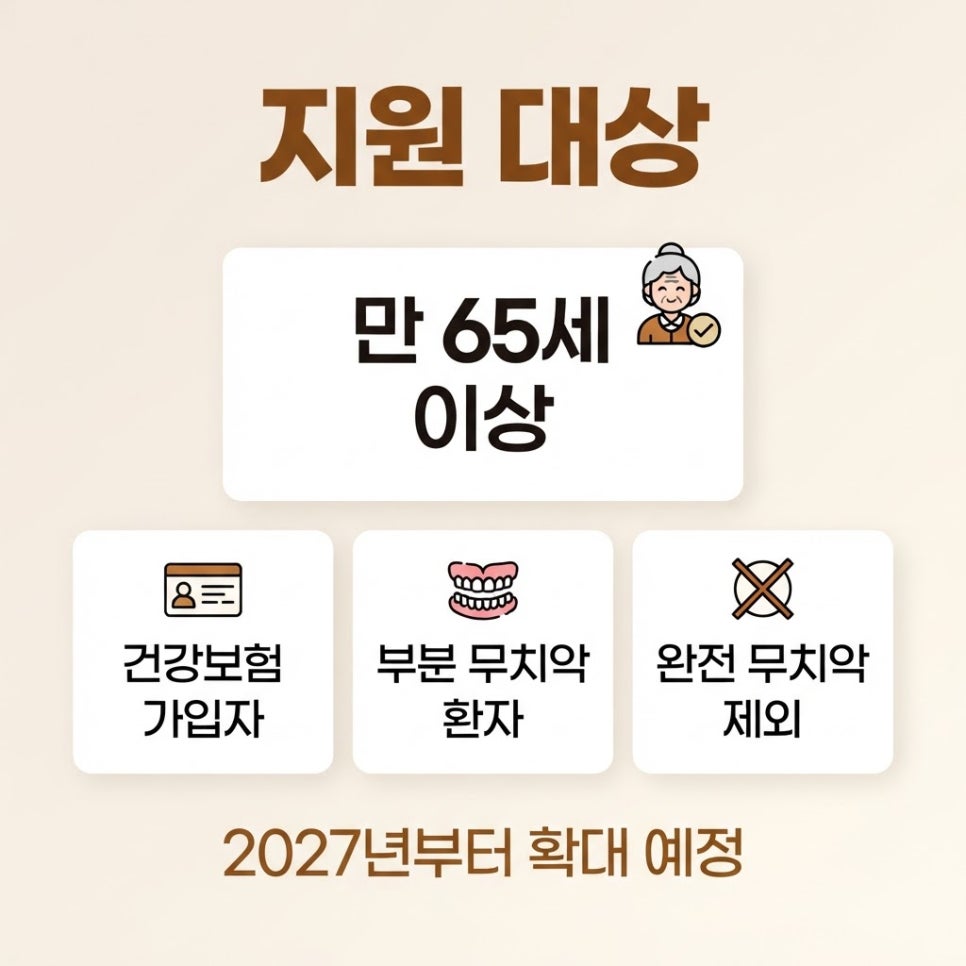
Dental implant benefits apply to health insurance subscribers or dependents age 65 and older; the indication is partial edentulism (complete edentulism is excluded).
This is how the National Health Insurance Service (NHIS) describes the policy in its dental implant benefit guidelines.
Whether an implant is actually feasible is ultimately decided by your dentist after a full evaluation of your jawbone condition and overall health.
How Much Will You Actually Pay Out of Pocket?
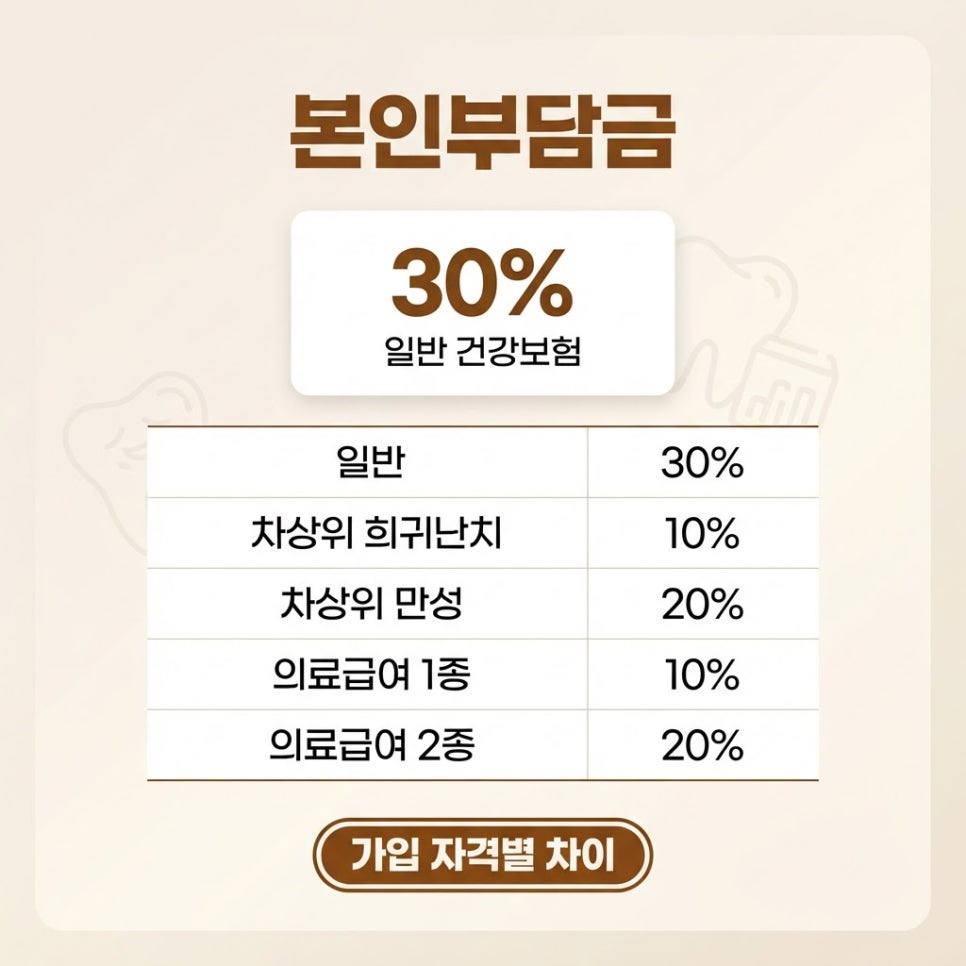
Standard health insurance subscribers pay 30% of the covered treatment cost.
However, the copay rate varies depending on your insurance category.
| Category | Copay Rate |
|---|---|
| Standard health insurance subscribers | 30% |
| Near-poverty rare/incurable disease patients, etc. | 10% |
| Near-poverty chronic disease patients, etc. | 20% |
| Medical Aid Type 1 | 10% |
| Medical Aid Type 2 | 20% |
For example, if the covered treatment cost is about 1,300,000 KRW,
a standard subscriber’s copay would be roughly 390,000 KRW.
This is a simplified example for illustration only — actual costs vary based on the fee schedule applied.
Keep in mind that this 30% rate only applies to the covered portion of treatment.
It does not mean you’ll pay just 30% of the total bill when non-covered procedures, like bone grafts, are also involved.
⚠ Bone grafts, sinus lift procedures, and similar treatments are not covered and are billed separately
⚠ Not every implant material or restoration type qualifies for coverage
How Do You Apply for Health Insurance Implant Coverage?
You need to complete beneficiary registration before treatment begins.
If treatment has already started as a non-covered procedure, retroactive coverage may not be possible.
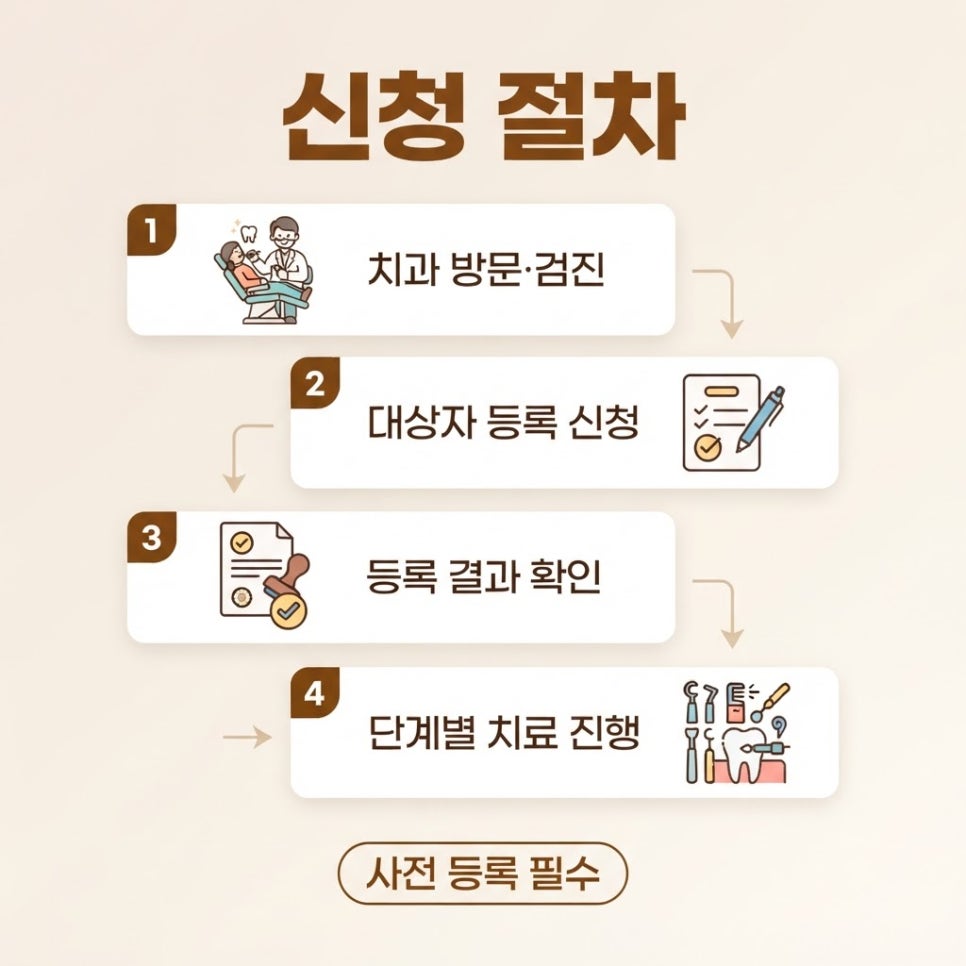
- Visit a dental clinic for an oral exam — to check which teeth are missing and assess jawbone condition
- Apply for beneficiary registration — your dental clinic can often handle this on your behalf
- Confirm your registration status with the National Health Insurance Service (NHIS)
- Proceed step by step through diagnosis, treatment planning, implant placement, and final restoration
What Should You Check Before Starting Treatment?

If your jawbone volume is insufficient and a bone graft is needed, expect additional cost.
Whether a procedure qualifies for coverage also depends on the implant material and restoration type used.
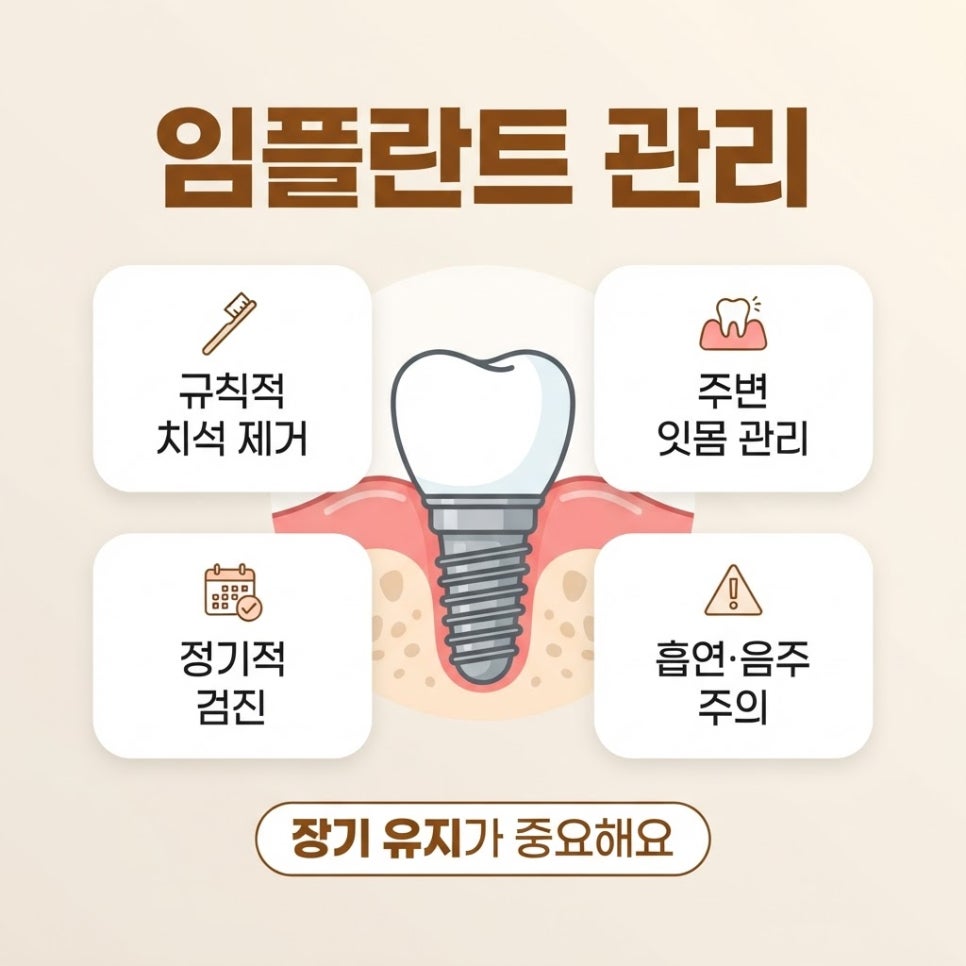
While the implant itself can’t develop cavities,
the surrounding gum tissue and jawbone can still become inflamed.
If you notice repeated bleeding or swelling, it’s best to see your dentist promptly.
✅ Have you confirmed you’re partially (not fully) edentulous?
✅ Have you checked whether you’ve already used your lifetime limit of 2 implants?
✅ Have you been told about additional non-covered costs, like bone grafts?
✅ Have you completed beneficiary registration before starting treatment?
helps you avoid unnecessary out-of-pocket spending and use your lifetime allowance of 2 implants where you need them most.
If you’re planning treatment, start with an oral exam
to confirm your insurance coverage and get an estimated cost.
For more information, you can also visit [My Life Dental Clinic] — a dental clinic with experience in implant treatment.
Frequently Asked Questions
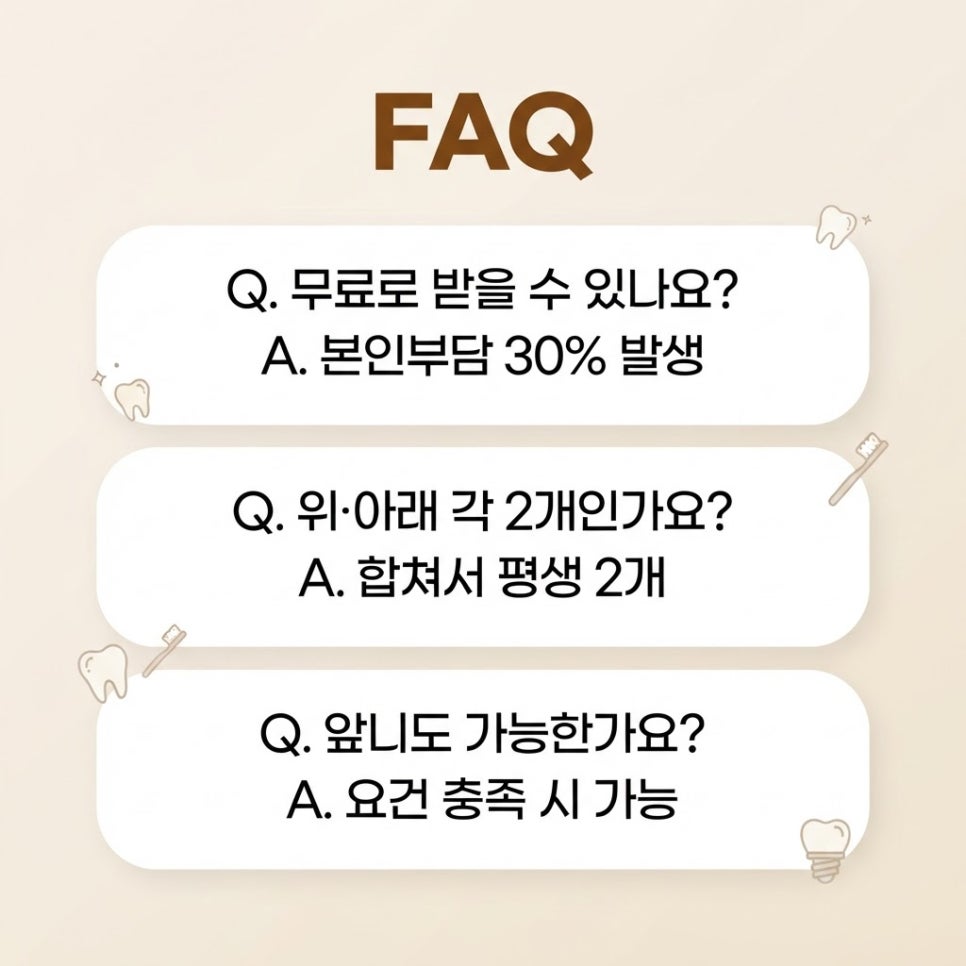
1. If I’m 65 or older, can I get 2 implants for free?
No. Health insurance covers up to 2 implants for life, but standard subscribers still pay 30% of the covered treatment cost.
2. Do I get 2 implants for the upper jaw and 2 more for the lower jaw?
No. The limit is 2 implants total per person, combining the upper and lower jaw.
3. Are front teeth eligible for health insurance-covered implants?
Yes. Both front teeth and back teeth can qualify for coverage if the requirements are met.
4. If I have no remaining teeth at all, is implant coverage unavailable?
Under current rules, fully edentulous patients are excluded from implant coverage and are instead classified for coverage under complete resin dentures.
5. I already started non-covered treatment at another clinic — can I apply for insurance coverage later?
Retroactive coverage is often difficult to obtain, so it’s safer to confirm your beneficiary registration status before starting treatment.
References
· National Health Insurance Service, “Dental Implant Benefit Guidelines,” National Health Insurance Service. View source
· Baekse Sidae, “Dentures Once Every 7 Years, Implants Twice for Life… Seniors Pay Only 30% of the Cost,” Baekse Sidae, 2023. View source
· Gov.kr, “Medical Aid Denture and Dental Implant Support,” Ministry of Health and Welfare. View source
This article is intended for general health information purposes only and is not a substitute for individual diagnosis or treatment. If you have symptoms, please consult a qualified dentist.